

Thanks to a generous donation from the Swiss Lung Foundation, every year the Swiss
Aerosol Group (SAG) can award a prize of 5'000 CHF to the best scientific publication
in the field of international Aerosol research, written from within Switzerland.
The prize will be awarded at the annual SAG conference, which takes place in November. The choice of the prize winner will be decided by the Prize Commission. The winner will present the awarded work at the annual conference.
Requirements:
As a rule, the work should come from a Swiss university, clinic or research institute.
The manuscript can be written in German, French or English and must be either accepted for publication in a peer-reviewed journal or published in a peer-reviewed journal not longer than one year.
The prize goes to the first author.
The application must include:
1) A nomination proposal
2) A curriculum vitae including a list of publications
3) A copy of the manuscript of the published work
The documents must be submitted by the 31st of August, in the year of the SAG conference which takes place in November, to the following address or internet address:
Dr. med. Otto Brändli
President of the Swiss Lung Foundation
Hömelstrasse 15
8636 Wald
contact to Otto Brändli ¦ submit Files
Prize Commission:
Prof. Dr. Beatrice Beck-Schimmer (University of Zurich)
Dr. med. Otto Brändli (President, Swiss Lung Foundation)
Prof. em. Dr. Peter Gehr (University of Bern)
Prof. Dr. Barbara Rothen-Rutishauser (Adolphe Merkle Institute, University of Fribourg)
Prof. Dr. Wendelin Stark (ETH Zurich)
Frau Lara Milena Lüthi MSc (BAFU)
Communication of the prize:
The prize winner will be introduced on the website of the Swiss Lung Foundation, and is requested to write a review article about the subject of the nominated work which will be published in Swiss Medical Weekly (SMW; http://www.smw.ch).
Fribourg/Zürich, 4.7.2016
 Download108.25 kB15/07/2016, 16:08
- Details
- Written by: Otto Brändli
- Category: Swiss Aerosol Award - Schweizer Aerosol Preis
-
Also available:

- Hits: 4716
 Medienmitteilung:
  press_summary_swiss_aerosol_award_luban_dada_2023.pdf28.35 KB
Die Preisträgerin 2023 Frau Dr. Luban Dada vom Paul-Scherrer-Institut in Villigen
(im Bild mit der Präsidentin des Preiskomitees Frau Prof. Barbara Rothen)
hat am 15.11.2023 in Bern ihre wichtige Arbeit präsentiert:
Auf einem Forschungsschiff in der Arktis hat sie im April 2020 ein extremes Wetter- und Luftverschmutzungsereignis
mit einem Temperaturanstieg von 30 Grad C und mit vielen Rauchpartikeln aus Kohlekraftwerken in
Russland und China beobachtet, welche für das rasante Abschmelzen des Polareises und auch die
extremen Wetterereignisse bei uns verantwortlich waren und weiter sein werden.
- Details
- Written by: Otto Brändli
- Parent Category: Swiss Aerosol Award - Schweizer Aerosol Preis
- Category: Preisträger
- Hits: 532
Press relase: SAG2022-englisch.pdf148.76 kB
This year we could present the award to two researchers for their excellent work out of many submissions:
Anne Lüscher
 The circulation of pathogens in the form of aerosols is an important route of transmission of diseases and respiratory infections in particular. However, the COVID-19 pandemic has once again shown that airborne virus distribution is extremely complex and that current understanding is insufficient to make accurate predictions about the transmission dynamics in practice. To improve this understanding, tracers - substances that behave similarly to aerosolized viruses in terms of size and properties - are essential. Anne Lüscher and her co-authors therefore developed a new tracing method to improve and simplify the study of indoor aerosol dynamics. In their award-winning work, they were able to show that silica particles with encapsulated DNA (SPEDs) can be deployed in aerosolized form, followed by recapturing and quantification at different positions. This is enabled by "DNA barcodes" enclosed in the particles: Short synthetic DNA sequences can be reliably detected by the PCR method with high accuracy and a sensitivity at the single-particle level. The silica matrix on the one hand protects the DNA and, on the other hand, can be produced size-specifically. In the published work, position-, ventilation- and time-dependent effects of indoor aerosol exposure could be demonstrated using SPEDs, enabling conclusions on the room architecture and air circulation. The proposed setup requires little technical infrastructure and is therefore mobile, making it particularly suitable for the investigation of real-life exposure scenarios in indoor settings, transportation scenarios and the environment.
Original title: Luescher, AM, Koch, J, Stark, WJ, Grass, RN. Silica-encapsulated DNA tracers for measuring aerosol distribution dynamics in real-world settings. Indoor Air. 2022; 32:e12945. https://doi.org/10.1111/ina.12945
Nadine Karlen
 At the University of Applied Sciences FHNW, Brugg-Windisch, a novel aerosol measurement method called DustEar has been developed that detects particles acoustically. It allows the direct measurement of the mass of single particles. From this, the PM concentration can be determined. In Switzerland particle PM exposure is regulated and total mass of airborne particles of health relevant sizes (e.g. PM10) is monitored. Therefore this measurement principle with its robust setting and direct measurement can make an important contribution in the field of aerosol monitoring.
Human health is affected by exposure to high or long-term aerosol concentrations. Due to their small size, aerosol particles can reach the lungs via the respiratory tract and also enter the bloodstream, where they can cause serious diseases. Therefore, limit values for aerosol mass concentrations are regulated by the WHO and need to be monitored. Due to the heterogeneity of aerosol concentrations and their complex interactions with the environment, long-term measurements of air pollution require both high spatial and temporal resolution for reliable statements about fluctuations or trends. Currently, there is no accurate way to determine mass-based exposure values or PM concentrations at specific locations in real time. To close this gap, DustEar enables reliable and cost-effective PM measurements.
In the awarded work, the proof of concept for a new measurement method was provided where aerosols are detected acoustically. The measurement principle allows the in-situ detection of liquid and solid particles. In the DustEar particles are accelerated in a nozzle and impact on a piezoelectric sensor. Each impacted particle generates a characteristic signal pulse whose amplitude is proportional to the particle mass. The study showed a current detection limit of 50 picogram particle mass that corresponds to a particle size of several micrometers. The challenges in the development of this measurement method included turbulence-free flow guidance with a defined flow profile, the design of a low-noise electronic circuit and the suitable selection of a piezo transducer. On the one hand, the transducer has to be robust against the noise of the air flow and, on the other hand, it has to be sensitive enough to detect the particle signals. The goal of a current Innosuisse project is to further lower the detection limit to submicrometer sizes. This requires special conditions, such as a particle impaction at reduced pressure, to ensure the impaction of the small particles. To be able to detect them, the signal-to-noise ratio must be improved by several orders of magnitude by increasing the particle velocity and optimizing the electronics and sensor technology.
DustEar combines the advantages of the state-of-the-art measurement methods in a simple, robust and portable measurement device based on direct mass measurement. Thus, it will enable a denser monitoring network with comparable reference devices that allow reliable long-term measurements. DustEar can also be used for source apportionment studies due to the size-resolved data.
The new measurement principle has the potential to make a valuable contribution to one of the most important research topics of our society: the improvement of air quality monitoring.
Information: Nadine Karlen, Research Associate, Aerosol measurement group, Institute for Sensors and Electronics, University of Applied Sciences, Windisch,
Original title: Single Aerosol Particle Detection by Acoustic Impaction; Source: https://ieeexplore.ieee.org/document/9768831
The Swiss Aerosol Award will be/was presented November 2nd 2022 at the 17th meeting of the Swiss Aerosol Group (SAG).
Thanks to a generous donation from the Swiss Lung Foundation, every year the Swiss
Aerosol Group (SAG) can award a prize of 5'000 CHF to the best scientific publication
in the field of international Aerosol research, written from within Switzerland.
- Details
- Written by: Otto Brändli
- Parent Category: Swiss Aerosol Award - Schweizer Aerosol Preis
- Category: Preisträger
-
Also available:
- Hits: 1419
Press relase: Press-Summary-Swiss-Aerosol-Award-2021.pdf133.8 kB
Fine dust exacerbates colds
Exposure to particulate matter alters the immune response of nasal epithelial cells in a way that makes it easier for cold viruses to multiply. This leads to a stronger inflammatory response, which is thought to be associated with more symptoms. This was shown by PD Dr. Loretta Müller and PD Dr. Jakob Usemann in their work - which was awarded the Swiss Aerosol Award 2021.
It has been known for some time that particulate matter and other air pollutants can influence the immune response and the reproduction of influenza viruses. However, it has not yet been investigated whether air pollution alters infection with the so-called rhinoviruses. Rhinoviruses are very frequent viruses and mainly cause the common cold. In children, however, rhinoviruses can also cause severe respiratory symptoms. In addition, rhinovirus infection may predispose for later asthma development.
In their award-winning work on the influence of diesel particles on the susceptibility of nasal epithelial cells to rhinovirus infection, PD Dr. Loretta Müller, group leader in the Pediatric Pneumology and Allergology at the University Children’s Hospital, Inselspital Bern and the Department of BioMedical Research (DBMR) at the University of Bern, and PD Dr. Jakob Usemann, consultant at the University Children’s Hospital Zürich and research associate at the Children's Hospital of Basel (UKBB), were able to show that prior exposure to diesel particles increases the amount of rhinovirus in nasal epithelial cells. This occurs via the downregulation of viral defense receptors and an upregulation of inflammatory messenger substances. The study, which included nasal epithelial cells from 49 children aged 0-7 years and 12 adults, also showed that the effects were independent of the participant’s age.
The Swiss Aerosol Award will be/was presented on 02 November 2021 at the 16th meeting of the Swiss Aerosol Group (SAG). The prize is endowed with CHF 5 000.
Information:
- Otto Brändli, Swiss Lung Foundation,
This email address is being protected from spambots. You need JavaScript enabled to view it. ; 079 688 53 37 - PD Dr. Loretta Müller, Pediatric Pneumology and Allergology, University Children’s Hospital, Inselspital Bern and Department of BioMedical Research (DBMR), University of Bern,
This email address is being protected from spambots. You need JavaScript enabled to view it. , 079 605 32 22 - PD Dr. med Jakob Usemann, PhD, University Children's Hospital Basel (UKBB),
This email address is being protected from spambots. You need JavaScript enabled to view it. , 076 441 95 18
Original title: Diesel exposure increases susceptibility of primary human nasal epithelial cells to rhinovirus infection
Source: https://www.ncbi.nlm.nih.gov/pmc/articles/PMC8451029/
- Details
- Written by: Otto Brändli
- Parent Category: Swiss Aerosol Award - Schweizer Aerosol Preis
- Category: Preisträger
-
Also available:
- Hits: 2318
Press relase: Download: swissaerosolaward_2020_englisch.pdf630.24 kB | Zusammenfassung.Sauvageat_Zeder.pdf144.79 kB
The 10th Swiss Aerosol Award has been presented at the annual conference of the Swiss Aerosol Society November 3, 2020 to Dr. Lukas Durdina (EMPA and ZHAW) for his publications on particulate emissions of a business jet and to Eric Sauvageat (Uni Berne) and Yanik Zeder (Swisens AG) for their work on Real-time pollen monitoring using digital holography.
Dr. Lukas Durdina and his Co-authors first reported particulate matter emissions of a business jet aircraft measured according to a new international emissions standard
Business aviation is a relatively small but steadily growing and little investigated emissions source. Regarding emissions, aircraft turbine engines rated below 26.7 kN thrust are certified only for visible smoke and are excluded from the non-volatile particulate matter (nvPM) standard. Emissions data for small engines are lacking. As the demand for air travel surges, fuel burn from commercial aviation is expected to double in 40 the next 15 years. The fleet is even predicted to grow worldwide by 33% in the next 8 years.
Small plane - low emissions?
Despite the small aircraft size and relatively low fuel burn, the nvPM mass emission rates were up to a factor of 3 higher than previously reported for the Boeing 737 engines. We have shown here that a modern business jet may emit as much nvPM from airport operations as an airliner. The comparison with airliners at cruise altitude suggests that nvPM emissions from a business jet flight may be higher than those of an airliner. Expressed as a per-person burden (assuming 180 airliner passengers and 5 business jet passengers), the nvPM mass emissions are higher by a factor of 72 and the nvPM number emissions are higher by a factor of 24.
This study will serve for the development of emission inventories and the results could also be used in the regulatory framework for assessing the emissions certification requirements of small aircraft turbine engines
Durdina, L., Brem, B. T., Schönenberger, D., Siegerist, F., Anet, J. G., & Rindlisbacher, T. (2019). Nonvolatile Particulate Matter Emissions of a Business Jet Measured at Ground Level and Estimated for Cruising Altitudes. Environmental Science and Technology, 53(21), 12865–12872. https://doi.org/10.1021/acs.est.9b02513
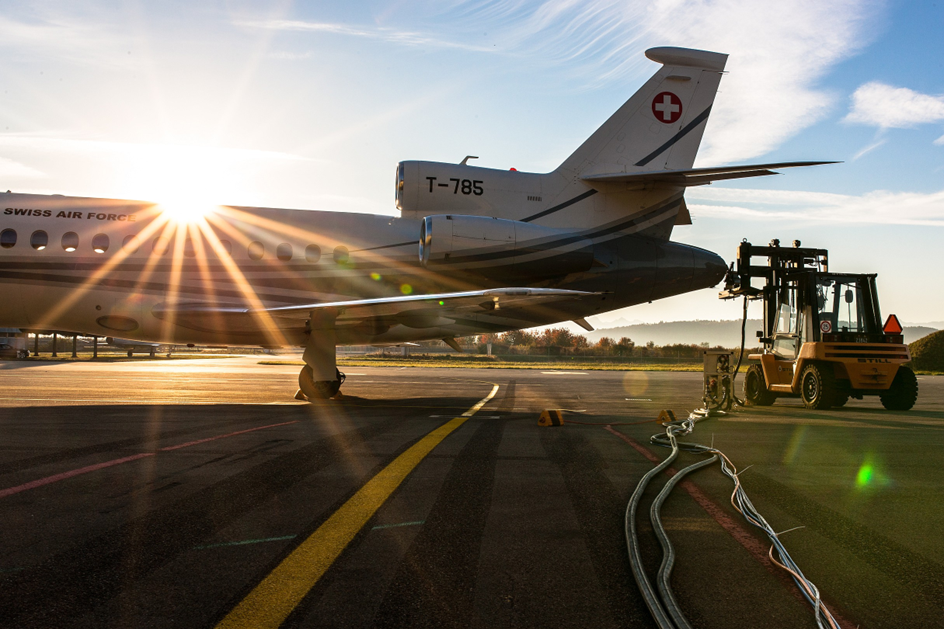
Sunrise above the Falcon 900 EX with the exhaust sampling probe and instruments in place. Photo: Lukas Durdina.
As new real-time pollen monitoring devices emerge, there is a growing need for processing the large amount of measurement data in an accurate and efficient way. Eric Sauvageat and Yanik Zeder develop and validate a new algorithm to classify real-time particle measurements taken by the “Swisens Poleno”. This instrument is currently the only operational pollen monitoring device using digital holography.
To identify and classify the pollen particles measured by the Poleno, the holographic images are first used to separate pollen candidates from other particles based on their general shape. As a second step a machine learning algorithm was developed and trained by inserting known pollen particles in the device. The resulting dataset is then used on the unknown pollen grains to discriminate between the different taxa. This two-step procedure enabled the system to identify and classify 8 pollen types, whereby 6 of them had accuracies greater than 90%. In addition to the classification ability of the device, the authors also investigated the counting accuracy of the Poleno by performing controlled chamber experiments.
(Sauvageat, E., Zeder, Y., Auderset, K., Calpini, B., Clot, B., Crouzy, B., Konzelmann, T., Lieberherr, G., Tummon, F., and Vasilatou, K.: Real-time pollen monitoring using digital holography, Atmos. Meas. Tech., 13, 1539–1550, https://doi.org/10.5194/amt-13-1539-2020, 2020)
- Details
- Written by: Otto Brändli
- Parent Category: Swiss Aerosol Award - Schweizer Aerosol Preis
- Category: Preisträger
-
Also available:
- Hits: 3374
- Swiss Aerosol Award 2019: emissions with a special focus on biomass burning
- All prize winners overview
- Swiss Aerosol Award 2018: Award for research into the emission behavior of direct-injection gasoline vehicles (GDI) (2)
- Swiss Aerosol Award 2017: Auszeichnung für die erste unabhängige Untersuchung des elektronischen Tabakheizsystems IQOS